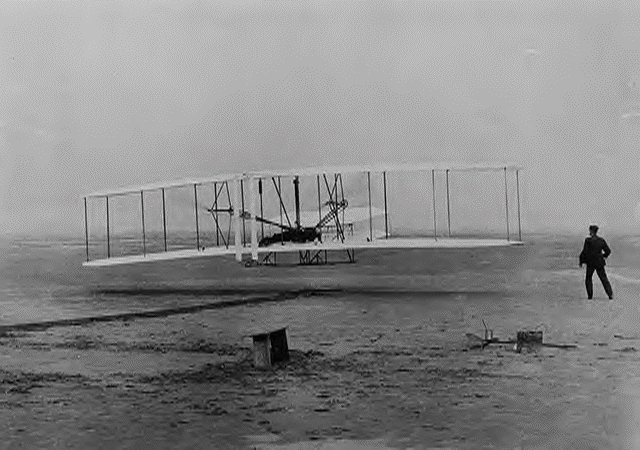
I've been reading the excellent biography of Apollo 11 astronaut Neil Armstrong, "First Man" - it's the only authorized book about Armstrong's life in existence, and it's only been out a few years. Anything dealing with the space program has always deeply fascinated me - one of my main "comfort food" DVDs is "For All Mankind", a stunning montage of moon mission footage and shimmering Brian Eno music that I can watch over and over, engaging and uplifting my spirits like few other things. I feel so very lucky to have been alive to witness this event, the moment we first stepped onto another celestial body.
In the book, I stumbled upon a detail I had never heard about before: each of the three Apollo 11 astronauts had a small, lunch-size bag sized pouch called a "Personal Preference Kit" (PPK), a teflon-coated bag that could weigh no more than 5 pounds, contents included. These were meant for the astronauts to be able to bring personal momentos to and from the Moon. The discretion about the contents of the PPKs was left completely to the astronauts, and while some have even auctioned off items they took on the journey, very little is known about the contents of Armstrong's PPK. In "First Man", a detail jumped out at me, and literally brought a tear to my eye: Armstrong apparently made an arrangement with the National U.S. Air Force Museum, and had been given a small piece of wood from the propeller of the Wright Brother's famous 1903 flyer, as well as a 8x13 inch piece of muslin fabric from the left wing, to include in his PPK.
The deeply touching symbolism of taking those pieces of the first flying machine to the Moon and back, just leaves me with a huge grin and a soft glow in my heart.
They also left some interesting items on the moon (at the very last moment before shutting the hatch - they almost forgot, according to the book), including a pair of Soviet-made medallions honoring Yuri Gagarin and Vladimir Komarov, as well as patches for Apollo 1 astronauts Gus Grissom, Ed White and Roger Chaffee, who had all died in a tragic launch pad fire incident.
AudioGeeks, rejoice: MVerb an astounding little reverb plugin, pro quality sound, fairly extensive controls, low processor draw and did I mention it's free? And open source? GarageBand, Live, Logic, Mac, Windows, it seems to work everywhere.
Obligatory public service announcement: with any reverb, you should always try to set the mix ration of dry/wet signal to 70/30, and tweak from there. On this little wonder, start at a setting of around 0.25 for the Mix knob, and adjust down, to less reverb. It's like salt - a little goes a long way. Reverb is an easy way to add a little virtual "air", or space, around any sound, but especially those generated artificially, like drum machines and synthesizers, as well as close-captured vocals. This thing sounds really, really good, it's a gem of a tool.
So there's this podcast show I co-created, and left this year... and recently, it seems like the audience has been less than thrilled with the new theme music the show is using - and I generally agree, the new stuff is corporate and bland - much like the new direction of the show. I had decided that I no longer wanted my music associated with the program, but given that folks seem to really like the original tune, the whole, unedited theme is up on the MetaFilter music page. I rarely share my music with anyone - it's definitely a personal quirk of mine; as public as I make my writing and podcast work, my music is another matter entirely, and besides a couple of close friends, this stuff was never meant for public consumption. I don't consider myself a very good musician, I just really enjoy making noise. No excuses.
The song, called "mizderE", was recorded in a couple of hours, using Ableton Live and a slew of plugins, some long-discontinued. Paracast fans, this is for you, as a show of appreciation for listening to my former podcast!
I recently had the pleasure of attending a screening of the captivating documentary "Deconstructing Dad - The Music, Machines and Mystery of Raymond Scott", lovingly created by Scott's son, Stan Warnow, a resident of the Hudson valley (the screening was sponsored by my friends over at Rivertown Film). The film is deeply personal, compelling blend of Scott's considerable talents in musical composition, electronics, audio synthesis, engineering and recording technologies. I've known about Scott for years - The Music of Raymond Scott: Reckless Nights & Turkish Twilights, and "Manhattan Research, Inc." are longtime parts of my collection, and are required listening for anyone who appreciates uniquely eccentric music.
Check out his very first hit song, Powerhouse, and ask yourself, why does this sound familiar?
Think Warner Brother cartoons.
Here's the trailer for the documentary:
In many ways, Scott was very much the Frank Zappa of his era, in that he worked with some of the top session musicians of the time, but reached the point where he seemed to feel that technology was the only way to recreate the complexity of the music running through his imagination. Scott hired a young Robert Moog right out of school, to help build early analog synthesis and sequencing hardware, culminating in a audio workstation called The Electronium.
Sequencing is what Scott ended up devoting a major portion of his creative efforts to later in life, and his elaborate electronic studio was the most powerful sequencer on the planet for some amount of time, an impressive achievement in any era. The Sequencer is essentially the tool for arranging the musical notes that are used to trigger sounds - in a player piano, the punched paper was the note sequence used to trigger the actual mechanical hammer assemblies.
While most DAW (Digital Audio Workstation) hardware and software is designed around the idea of combining MIDI sequencing with sampled-audio tracks (live, mic'd instruments and recorded vocals), there is one particular program that goes far beyond the typical sequencing capabilities found in most programs - it's a Mac-only marvel called Numerology, and there's absolutely nothing like it on any other platform. It uses the flexibility of software to deliver sequencing potential that literally blows my mind... and it would have made Raymond Scott smile ear-to-ear, no question. I did a review for Mac|Life that merely scratches the surface of this addictive wonder, and it's just one of those situations where it's hard to clearly explain the amazing depth of this uniquely creative, deeply fascinating musical production tool.
Watch this movie, and you'll start to understand the possibilities.
It uses any Audio Units synth and effects plugin you have installed in your Mac (and there are LOTS of those floating around), and there's no question that it's one of my desert island picks. It's the fruits of the mind of an amazingly talented creative programmer/musician, James Coker, who has come up with something so special, he deserves a MacArthur Award for his efforts. For $119, you can enjoy the same level of potential that took Raymond Scott many years, and thousands of dollars, to cobble together. If ever someone's soul could haunt a piece of software released years after his passing, well, I'd be willing to bet there's some Scott lurking somewhere deep in Numerology.
Anyone who does any type of field recording already knows about the very popular Zoom H2, which I reviewed for Mac|Life some time ago. Overall, I thought it offered an amazing value for the money. Well, Samson Technology has just announced the H1, which is supposed to deliver the exact same microphones and basic specs for, get ready, $99, which is just nuts. I can't imagine it's built any worse than the H2, and it looks like they've really simplified the interface, which some felt was a bit overwhelming in the H2 (I personally have had zero problems figuring out the controls, but then again, I'm me). I can't wait to get ahold of this thing, I suspect it's going to sell like gangbusters. Just one thing, though - Samson, we'll all survive without the 2 gig card bundled with the unit, feel free to donate mine to charity.